Process

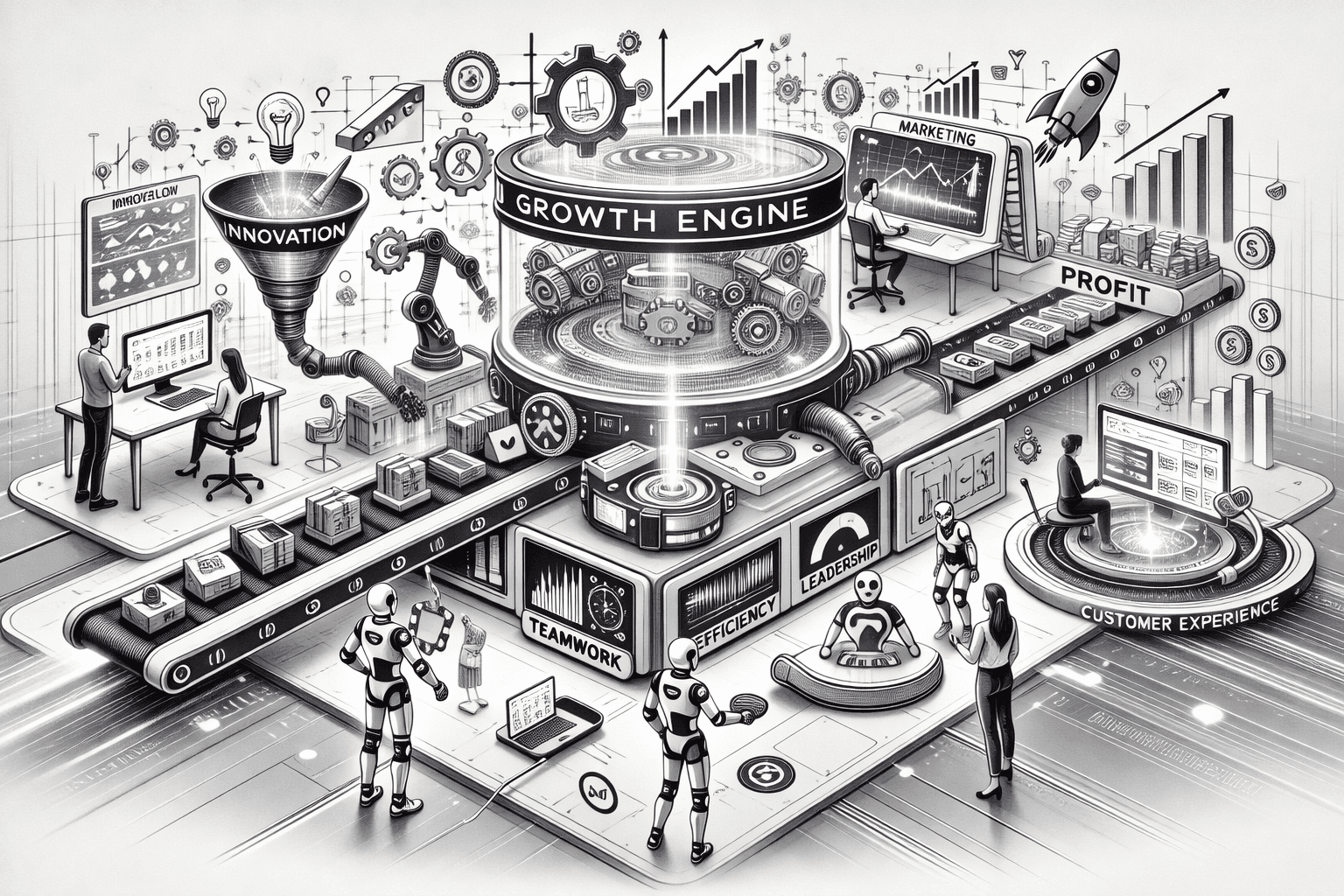
What is a growth engine? And how we build them.

AI can't automate chaos: Why your company needs an operating model to become a growth engine

There's a moment every successful commerce brand hits, usually somewhere between €5M and €50M in revenue. Where what got you here won't get you there.

You've added new countries. New sales channels. Expanded your catalogue. Hired more people. Each addition made sense at the time. Each was supposed to accelerate growth.

Instead, you're moving slower than ever.

Welcome to the complexity trap. And if you're reading this, you're probably in it. The growth paradox nobody talks about. Here's what I learned scaling Ace & Tate from 3 to 20+ countries online and 7 to 73 stores offline:

Growth drives complexity, and complexity is the silent killer of growth.

Every new channel needs integration. Every new country needs localization. Every new tactic needs processes. Every new hire needs alignment.

Before you know it:

  • Your tech stack has 47 disconnected tools

  • Marketing can't get the data they need from operations

  • Simple feature changes take weeks instead of hours

  • Nobody can answer "what's actually working?" with confidence

The irony? You're growing, but you're trapped. And the bigger you get, the bigger problem becomes.


Why "Let's just add some AI" won't save you

Right now, every consultant is selling AI as the solution. "Automate everything! Use agents! Deploy copilots!" But here's the truth that nobody wants to hear:

AI can't automate chaos.

Think about it. If Sarah in marketing is the only one who knows how your content approval process works, AI can't scale her brain. If your data lives in 12 different systems with no single source of truth, AI will just give you faster wrong answers. If nobody owns the customer journey end-to-end, AI agents will just execute bad processes more efficiently.

I've watched this play out dozens of times. Leadership gets excited about AI. They run pilots. Some work, most don't. Six months later, nothing has fundamentally changed except the budget is smaller and the team is more skeptical.

The problem isn't the technology. It's what comes before. Fix the foundations first. Before AI can deliver on its promise, you need four foundations in place:

1: Unified data: Clean, centralized data in a single source of truth. Because AI learns from data—garbage in, garbage out.

2: Clear processes: Documented workflows that AI can follow and humans can audit. If it only lives in someone's head, it can't be automated.

3: Integrated systems: Connected tech stack where data flows automatically. AI needs to see across systems, not get trapped in silos.

4: Defined roles: Clear ownership, decision rights, and accountability. AI without ownership just deepens the chaos.

This is what we call Conway_OS; an operating model for your commerce engine.

Not sexy. Not trendy. But absolutely essential if you want to win with AI. This method has been developed based on our 20+ years of experience building digital companies.


How winners actually win

After tracking 250+ leading commerce brands and consulting with 40+ ambitious brands across Europe, we've reverse-engineered what separates winners from everyone else. It's not that they have better products. Or bigger budgets. Or smarter people.

It's that they approach growth as a system. Winners have mastered four fundamental drivers:

Driver #1: Sustainable Traffic

They acquire customers for less than their lifetime value. This creates a self-funding growth engine with a healthy LTV:CAC ratio (target: 3:1).

They don't chase growth hacks. They build the 3C Flywheel: Commerce → Content → Community. Each reinforces the other.

Driver #2: Seamless Conversion

They help people make purchase decisions across every touchpoint. Not just "add to cart" buttons, but content, tools, and experiences that reduce friction.

They're experience-led, not commerce-led. They understand that modern customers switch between channels constantly, and they design for that reality.

Driver #3: Repeatable Retention

They deliver experiences so good that customers tell their friends. They own the customer relationship through unified customer IDs and automated lifecycle marketing. Balancing your customer acquisition cost (CAC) to your lifetime value (LTV) to create a self-reinforcing payback mechanism.

New customers come from the actions of past customers. That's the mechanism.

Driver #4: Streamlined Operations

They've mapped their workflows, documented their processes, and built integrated systems. This is what makes AI actually useful. Fix the foundations first to unlock the promise of AI: do more with less resources and higher quality output.

Every company consists of workflows. Winners break these down, identify what can be automated, and assign work accordingly.

From Chaos to Confident: Delivering long-term growth

When you implement an operating system, something shifts.

Instead of:

  • Scattered tactics → You have a unified system

  • Siloed teams → You have cross-functional ownership

  • Dashboard watching → You have AI-augmented decision making

  • Stagnating growth → You have self-funding momentum

Your team starts playing by the same rules, watching the same scoreboard, and executing the same playbook. This is when AI stops being a science project and starts multiplying capability.

This is the simple math that matters. At the end of the day, winning the commerce game comes down to mastering this simple equation:

Traffic × Conversion × AOV = Revenue (optimized for Footprint & NPS)

And the underlying mechanism:

LTV:CAC

Everything else; your tech stack, your processes, your AI agents, all your capabilities exist to move these numbers in the right direction.

I know this isn't the sexy message. You probably clicked hoping for "10 AI Hacks to 10x Your Revenue.", but after 20+ years building and scaling digital companies, here's what I know for certain:

Amateurs have goals. Professionals have systems.

The brands winning in the age of AI aren't the ones with the most advanced models. They're the ones who built the operating system first.

They mapped their workflows. Unified their data. Integrated their systems. Defined their roles. Built their execution muscle.

Then they deployed AI and it actually worked.

What's Your Next Move?

If you're stuck in the complexity trap, you have two choices:

  1. Keep adding tools, tactics, and AI pilots, hoping something breaks through

  2. Step back, build the operating system, then scale with confidence

The second path is harder in the short term. It requires honesty about what's broken. It demands cross-functional alignment. It takes discipline to document what's only in people's heads.

But it's the only path to sustainable, long-term growth.

Ready to build your growth engine?

I share frameworks, case studies, and practical learnings on building commerce engines for the age of AI. No fluff. No hacks. Just systematic approaches that actually work.

Follow me on LinkedIn for weekly insights on how to deliver long-term growth.

Image of client success manager

Hello.

Feel free to reach out if you have any questions. We are happy to invite you to our studio in Amsterdam.

Sign up for our newsletter

By submitting, you agree to our Terms and Privacy Policy.