AI can’t automate chaos
Why AI only works when the workflows, decisions and systems underneath it are understood first.
There is a moment that almost every growth-stage company eventually experiences.
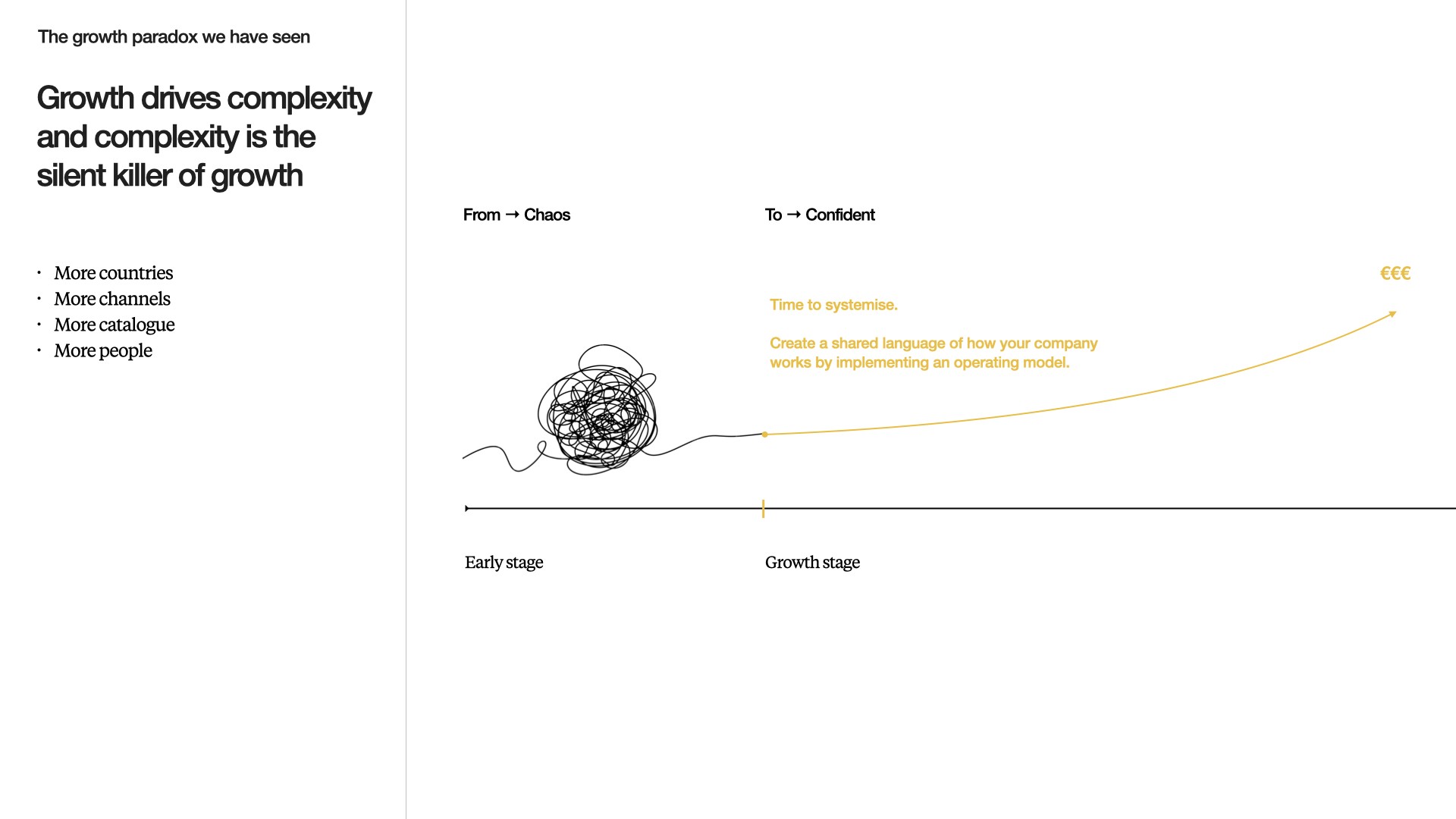
It usually happens somewhere between €20 million and €200 million in revenue. The company is no longer a start-up, but it isn’t yet a machine. There are more countries. More channels. More SKUs. More people. More dashboards. More tools. More meetings.
And then someone in the boardroom asks:
“Why aren’t we using AI?”
It’s a reasonable question. After all, AI promises something beautifully simple: do more work in less time at higher quality output .
But here’s what most companies discover, usually the hard way:
AI can’t automate chaos.
The problem isn’t the technology. It’s what comes before it .
And that’s where we start.
The growth paradox
Growth drives complexity. Complexity is the silent killer of growth .
In the early stage of a company, intelligence lives inside people. A head of marketing knows the funnel by heart. The operations lead knows every exception in the warehouse. The CFO understands which numbers matter.
Execution is limited by the capacity of your workforce.
Then something shifts.
You expand internationally. You add channels. You introduce new systems. You hire specialists. Intelligence fragments. Work becomes distributed across tools, spreadsheets, Slack threads, and human memory.
And suddenly, you have more capacity, but less clarity.
At that point, most AI initiatives fail. Not because the model is wrong. Not because the prompt is weak. But because the company itself isn’t systemised.
AI needs structure. It needs clean processes. It needs unified data. It needs ownership.
Without those foundations, AI simply accelerates confusion.
A different way to think about companies
Most companies see themselves as an org chart.
We see something else.
We see workload and workforce.
Workload is the total amount of work that needs to be done.
Workforce is the total capacity available to do it.
Traditionally, workforce meant humans.
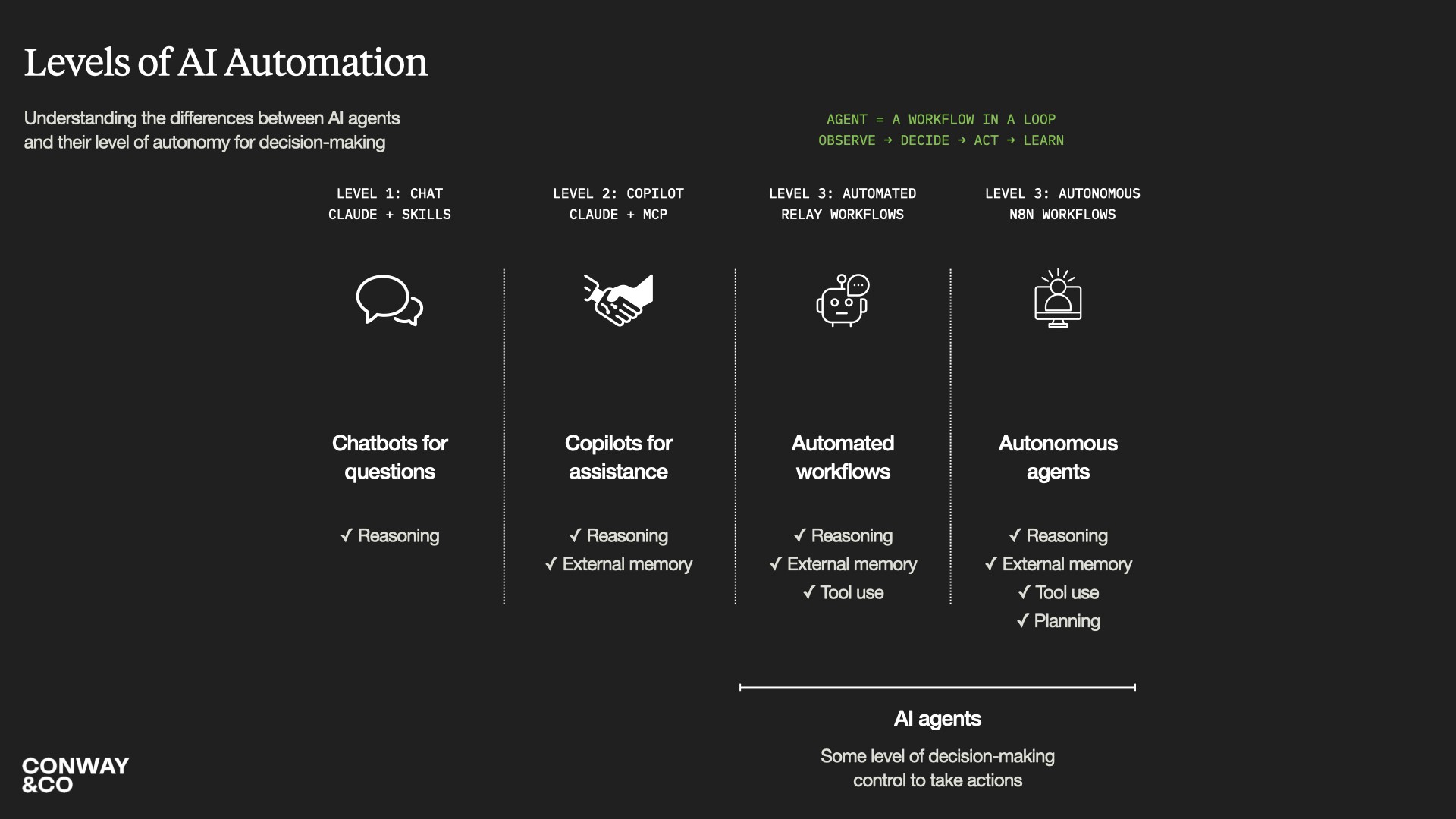
Now it means humans and agents.
A hybrid workforce.
That’s the shift.
An AI agent is not magic. It is, at its core, a workflow in a loop: observe, decide, act, learn . It can take instructions, use tools, access memory, and execute tasks across systems. It becomes a digital worker.
But just like a human worker, it needs context, boundaries, and integration into a system.
You don’t install AI.
You design a hybrid workforce.
Why most AI consultancies miss the point
The market is currently full of AI enthusiasm.
Chatbots. Copilots. Prompt engineering workshops. Innovation labs.
These are interesting. They are rarely transformational.
Because they start at the surface level: the tool.
We start deeper.
We begin by breaking down your company from the value chain to value streams, from workflows to processes, and from processes to individual tasks.
Let’s take commerce as an example.
Every brand operates through recurring workflows:
Make
Attract
Convert
Deliver
Support
Keep
Account 
Within “Attract,” you might have content production. Within that, tasks such as defining tone of voice, writing articles, translating versions, distributing content.
AI doesn’t replace “marketing.”
It automates specific tasks within specific workflows.
That distinction changes everything.
From org chart to work chart
In most companies, people are defined by roles. But roles are simply collections of tasks.
And not all tasks are equal.
We use a capability ladder that distinguishes five levels of complexity—from “button pushers” to “game changers” .
At the lower levels:
Tasks are repetitive.
Objectives are clear.
Instructions are explicit.
These are ideal for automation.
At the higher levels:
Problems are ambiguous.
Strategy matters.
Judgment and context dominate.
These remain human.
AI agents don’t replace roles.
They replace specific tasks within roles .
That’s how you elevate your workforce instead of threatening it.
When done correctly, your most expensive talent stops pushing buttons and starts shaping systems.
The foundations most companies skip
We’ve seen the same pattern repeatedly across commerce brands.
AI initiatives fail when four foundations are weak:
Unified data – AI learns from your data. If it’s fragmented, so are the outputs .
Clear processes – AI cannot scale “how Sarah does it.” It needs documented logic .
Integrated systems – AI needs visibility across tools. Silos kill automation .
Defined roles and ownership – AI without accountability deepens chaos .
This is why our work is not AI-first.
It is operating-model-first.
A scalable company operates as a system, with technology as its backbone .
Only then can AI amplify it.
Workflow-led automation
Most automation efforts start with the question:
“What tool should we use?”
We ask a different question:
“Where in your workflows does automation create measurable impact?”
This approach (workflow-led automation) ensures that every AI initiative connects to business outcomes.
For example:
Reduce cost per creative.
Shorten reporting cycles from days to minutes.
Increase lifetime value through automated lifecycle flows.
Eliminate manual CRM hygiene work.
The key metric becomes simple:
Time saved per week .
Time saved compounds into:
Lower operational cost.
Higher output quality.
Faster iteration.
Stronger margins.
AI becomes a lever for operational leverage, not a novelty.
From rollout to ROI
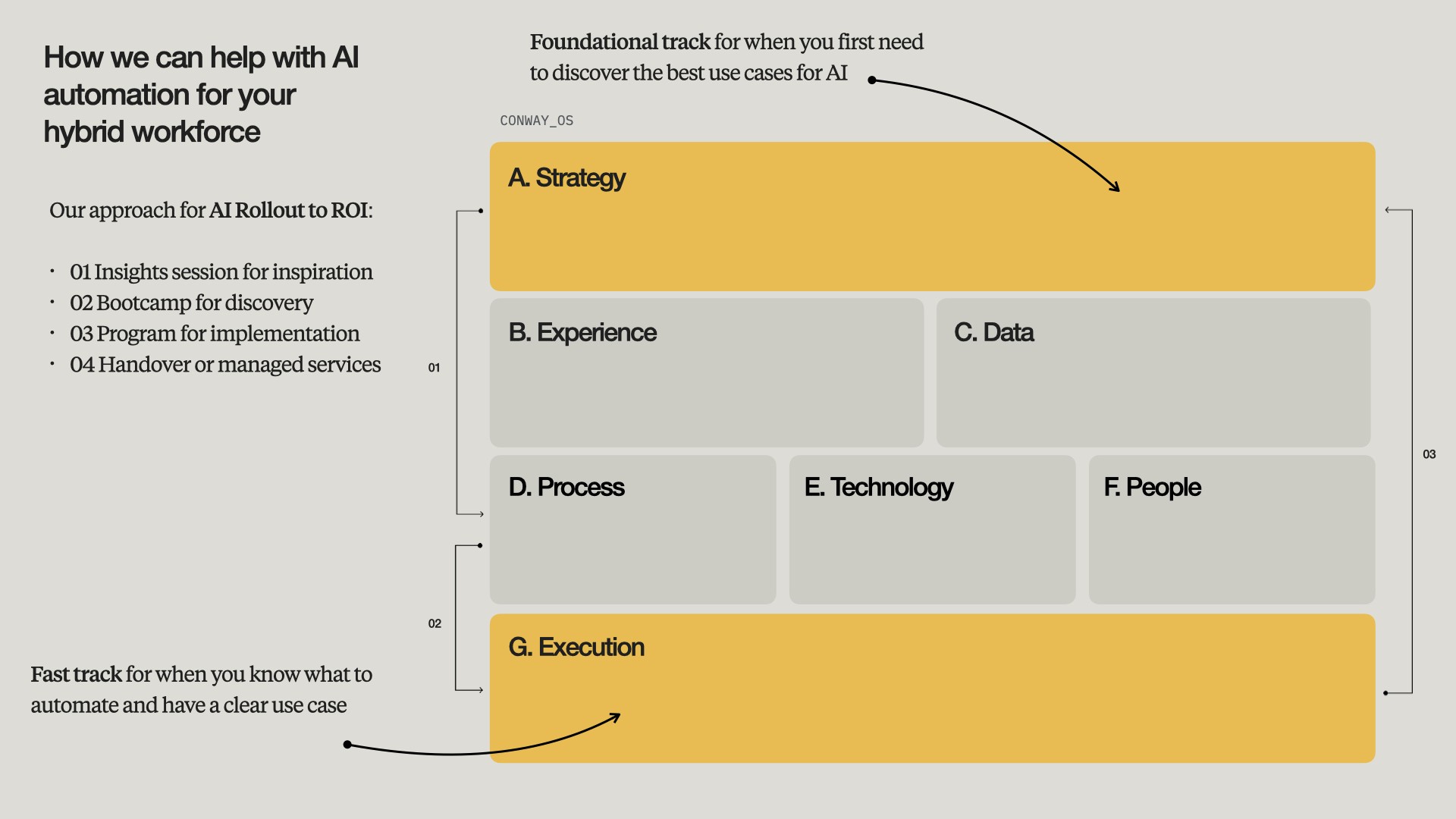
Our approach to AI automation follows a clear path :
Insights session – Align leadership on ambition and opportunity.
Bootcamp – Map workflows and identify high-impact use cases.
Implementation program – Build agents, integrate systems, deploy automation.
Handover or managed services – Monitor, optimize, and scale.
We don’t leave you with a pilot.
We build a capability.
The goal is not a chatbot.
The goal is a self-running company operated by a hybrid workforce of humans and agents .
What makes us different
There are many AI vendors. There are many digital agencies.
We are neither.
We are an AI-native engineering studio for agents, software, and data, focused specifically on B2C and B2B commerce .
What differentiates us is simple:
We systemise before we automate.
We design operating models, not experiments.
We build reusable infrastructure, not one-off demos.
We measure impact in time saved, cost reduced, and margin improved.
We stay embedded until ROI is visible.
In other words, we don’t help you “use AI.”
We help you redesign how your company works.
The quiet future
There is a seductive narrative around AI: that it will replace everyone, overnight.
We don’t believe that.
We believe something quieter and more powerful.
AI agents will become your first digital employees. They will take over repetitive tasks. They will monitor systems. They will generate reports. They will trigger workflows. They will operate in loops.
Your human team will move up the capability ladder, toward judgment, strategy, and creative problem solving.
The companies that win will not be the ones with the most AI tools.
They will be the ones that build the most coherent hybrid workforce.
And that begins not with a prompt.
It begins with understanding how your company actually works.
If you’re ready to move from chaos to confidence, from experiments to infrastructure, from hype to ROI—
Let’s build your hybrid workforce.